
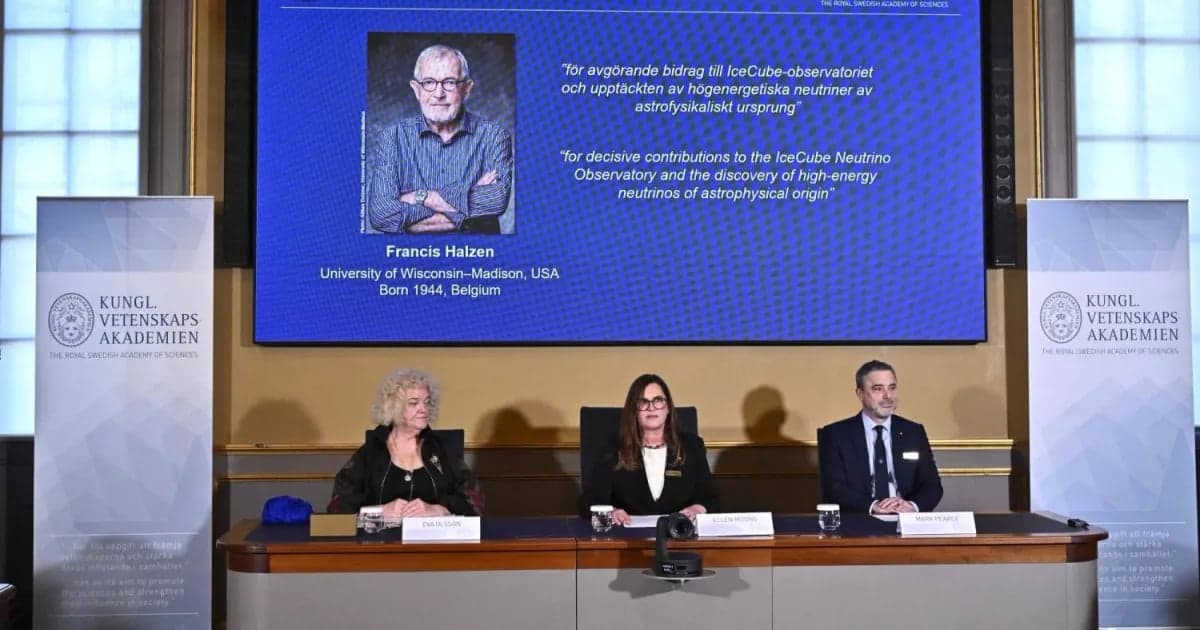
Francis Halzen awarded 2026 Nobel Prize in Physics for neutrino research
AI Summary
Physicist Francis Halzen has won the 2026 Nobel Prize in Physics for his pioneering work on the IceCube Neutrino Observatory and the detection of cosmic 'ghost particles.'
The Royal Swedish Academy of Sciences has awarded the 2026 Nobel Prize in Physics to Francis Halzen for establishing the IceCube Neutrino Observatory at the South Pole.
Prof. Francis Halzen, a Belgian-born physicist and U.S. citizen at the University of Wisconsin–Madison, was recognized for his vision in detecting high-energy neutrinos from space. According to OnlineKhabar and the BBC, Halzen developed the concept of using a cubic kilometer of Antarctic ice to track these elusive subatomic particles, often referred to as "ghost particles."
The IceCube Observatory, completed in 2011, uses thousands of sensors on cables frozen into the ice to detect rare flashes of light. These flashes occur when a neutrino occasionally collides with an atomic nucleus, producing fast-moving charged particles that emit a blue glow. This process allows scientists to trace the origins of high-energy neutrinos produced by violent cosmic events in distant galaxies.
During a news conference reported by the BBC, Halzen expressed surprise at the project's success, noting that while the idea was considered good when it started, few believed it would actually work. Prof. Mark Pearce, Chair of the Nobel Committee for Physics, credited Halzen’s tenacity and leadership with providing a "fantastic instrument" that has established a new form of astronomy.
While neutrinos are found throughout the universe and billions pass through the human body every second, Halzen's work focused on much higher-energy particles than those produced by the Sun. The Japan Times noted that Halzen now joins the ranks of historically significant laureates such as Albert Einstein, Max Planck, and Marie Curie.
Background
Halzen first proposed the vision for detecting neutrinos using South Pole ice in 1988. The IceCube Neutrino Observatory was eventually built at the South Pole in 2011, covering an area of one cubic kilometre to capture signals that ordinary telescopes cannot easily see.
How outlets covered it
NatureNobel physics prize awarded for detection of ghostly neutrinos
 Image: Latest articles - The Japan Times
Latest articles - The Japan TimesFrancis Halzen wins 2026 Nobel Prize in physics
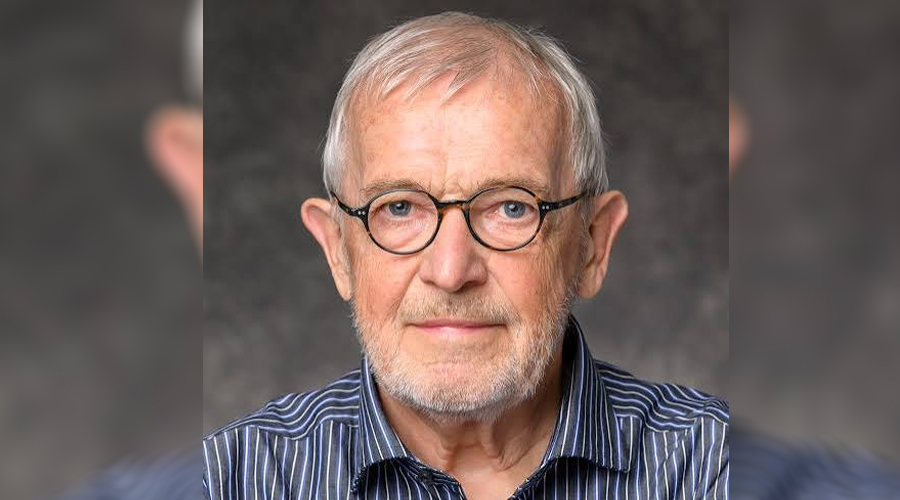 Image: OnlineKhabar English News
OnlineKhabar English NewsNobel Prize in Physics awarded to Francis Halzen
 Image: BBC News
BBC News'Ghost particles' from space telescope wins physics Nobel
Image: "when:24h site:reuters.com" - Googl
"when:24h site:reuters.com" - GooglFrancis Halzen wins 2026 Nobel Prize in Physics - reuters.com
Get our daily briefing first.
We're starting a short daily email with the stories most outlets are covering. Join the list to get the first one.
Free. No spam.
Discussion
No comments yet. Be the first to start the conversation!